July Consumption
Fiction, non-fiction, movies, TV... Oh my!

This article, and all my work, is made possible by the incredible generosity of my paid subscribers. Your support is particularly important for longer projects such as The Genre Genealogy Series, which I intend to continue offering for free to everyone. If you enjoy my writing, please consider joining our community as a paid subscriber.
Prefer to offer one-time support? I have a ‘Buy Me A Coffee’ site here.
Welcome, welcome, welcome,
to a slightly different kind of monthly round-up. Lately, I’ve been thinking about how easy it is to limit our recommendations and round-up strictly to fiction. But for me, every novel is just a gateway to some other media form: a book leads to an article, which leads to a film or TV series, which inevitably leads me right back to another book. They are all linked. So, I’ve decided to upgrade my reading round-up into a broader media consumption log.
In conjunction with this, over in this week’s paid subscriber post, you’ll find an article exploring a recurring theme I noticed in my consumption this month, which is the domestic space.
If you’d like to follow my current reads, TBR, or see the books I’ve left off this list, you can find me on Goodreads here:
Fiction.
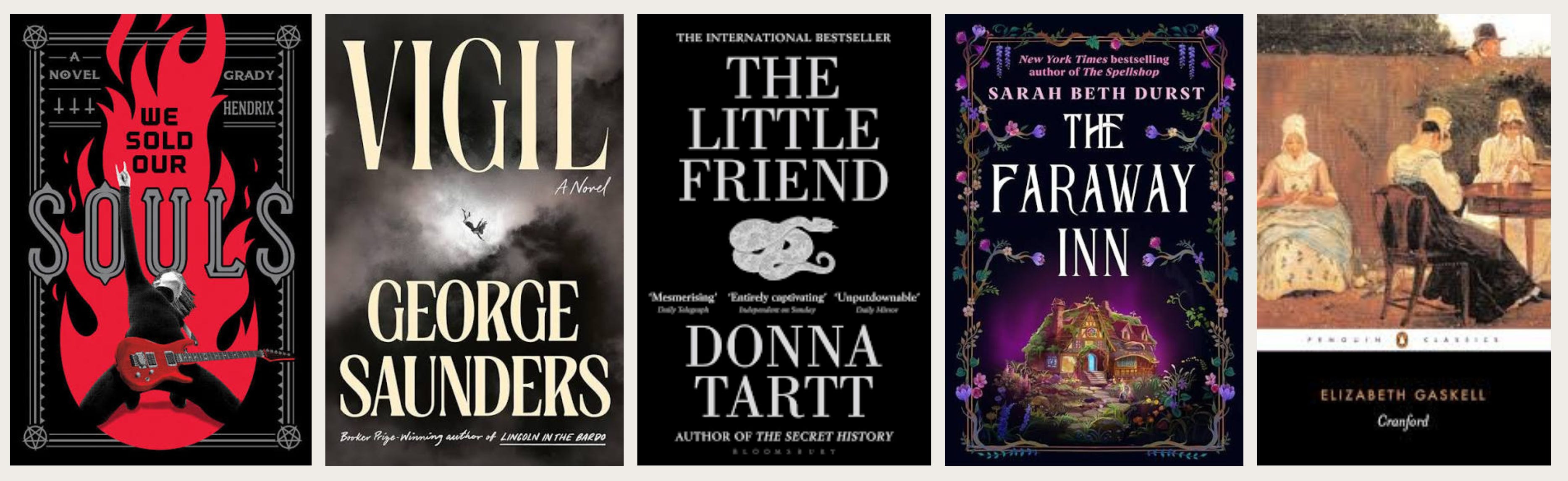
The Faraway Inn, by Sarah Beth Durst
I picked up The Faraway Inn without realising it was YA. I have loved the adult cozy fantasies that Sarah Beth Durst has been publishing recently and was excited. I read the first two chapters, made the realisation, put it down, intending to leave it there. But I couldn’t stop thinking about the main character, so the next afternoon I picked it back up, put away my adult cynicism (— grown-up responsibilities) and read it in two sittings. It is low-stakes, teenage angst, overachieving female main character(s), set in a whimsical inn with secrets, gargoyles, a cat and a cast of magical characters (—literally magical) If you enjoyed The Spellshop and The Enchanted Greenhouse, this is for you.
Cranford, by Elizabeth Gaskell
Cranford is one of those books that sat on my shelf for over 20 years, a title I never quite seemed to reach for. But after making a promise to myself at the beginning of the year to finally tackle the books on the damn shelf, I finally picked it up.
Strictly speaking, Cranford is less a traditional novel and more a series of interwoven stories set in a small English country town, told through the perspective of Mary Smith, a frequent visitor to the area. The bulk of the tales revolve around Miss Deborah Jenkyns and her sister, Miss Matty, offering a glimpse into their pasts, extended families, and old beaux.
It is a sweet look at small-town life that is funny in places and genuinely sad in others. However, I think it is best enjoyed by taking in a story here and there, rather than doing what I did and reading it straight through. By the end, reading it all in one go made the episodic structure start to feel a bit repetitive and grating.
Vigil, by George Saunders
George Saunders’ newest offering comes in novella form. It follows Jill—who is either an angel or simply a helpful spirit, though what she actually is remains wonderfully ambiguous. Her task is to help a dying, immoral businessman named K.J. Boone come to terms with the wrongs of his past, pushing him to finally take accountability rather than making excuses for his actions.
Saunders doesn’t tread lightly with his themes in Vigil, and the book can occasionally come off as a bit heavy-handed or overly didactic. Boone’s business empire caused massive environmental destruction. Jill trying to have him take accountability for this leads to heavy environmental and climate crisis discussions that raise pressing questions about who is to blame and how they should be held accountable. Personally, I didn’t mind that element at all, as these are urgent and legitimate questions to explore.
The Little Friend, by Donna Tartt
I’m almost embarrassed to admit this is only my second Donna Tartt (—I haven’t read The Goldfinch yet, but intend to very soon). Given the length of her books, I’m secretly grateful she only publishes once every decade (—though that also means we are well overdue for a new Tartt novel!)
Reading The Little Friend was quite an experience. I felt like I was holding my breath the entire time, making it both an exhilarating and exhausting read.
We follow Harriet as she tries to solve the mystery of who murdered her brother 12 years prior. Because she was only a baby at the time and remembers nothing, we as readers discover things right along with her. Set deep in the South, the book very aptly earns its Southern Gothic label. With its snakes, old houses, nosy neighbours, and unsolved murder, I absolutely loved it!
On a side note: there is something I love about a dark novel told from a child’s perspective. King does this really well; think of It, The Girl Who Loved Tom Gordon, certain chapters of Needful Things and Carrie. Also, there’s The Cement Garden by Ian McEwan and Boy Swallows Universe by Dalton. Would love to hear of any others you recommend!
We Sold Our Souls, by Grady Hendrix
We Sold Our Souls was the only Grady Hendrix book I hadn’t read yet, and it taught me a very important lesson: sometimes the narrator of an audiobook is the entire reason you aren’t enjoying a book. I don’t know what it was, but I just kept dreading hitting play on this one. Finally, I decided to borrow the physical book from my library, picked it up right where I had left off, and ended up loving the story.
In this novel, we follow Kris, a former heavy metal guitarist who was ousted from her band under mysterious circumstances she can no longer remember. The book is her journey to piece together the terrifying occurrences of that night, ultimately culminating in a crazy concert scene you really have to read to believe (—these epic final scenes are where Grady Hendrix truly shines!).
Non-Fiction.
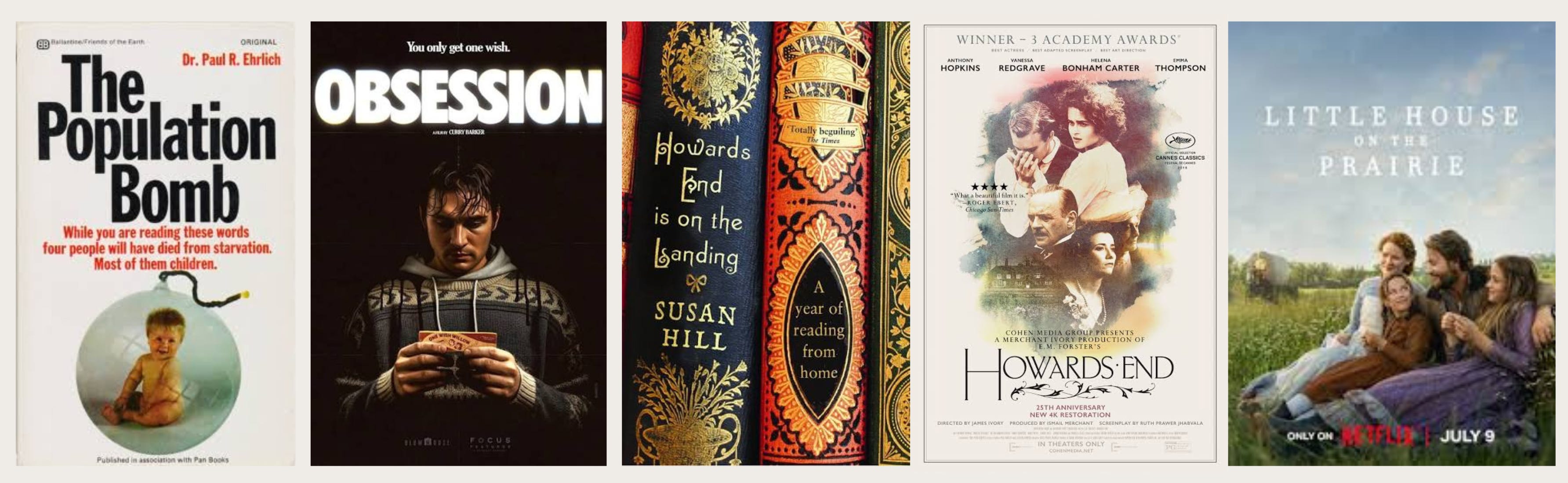
Howards End Is on the Landing: A Year of Reading from Home, by Susan Hill
This book was an accidental find. I was trying to find a second-hand copy of Howard’s End after watching the film (—as I discuss below) and this came up in the search results. I noted the author (—the author of The Woman in Black and Mrs de Winter) and clicked add to cart. This is a collection of essays about books and reading, each inspired by books Hill discovers forgotten around her home. Susan Hill has close to 30 books to her name and has been in and around the publishing industry for decades. My favourite thing about this book is the many little memories of other authors she has crossed paths with; for example, there is a wonderful scene where she is in the library and picks up a book an elderly gentleman has dropped, only to discover the elderly gentleman is E. M Foster! Can you imagine!
The Population Bomb, by Dr. Paul Ehrlich.
Reading The Population Bomb was research for a novel I’m currently working on. Published in the late 1960s, it’s an influential and intensely controversial environmental warning book built on a simple premise: the Earth’s human population is growing at an exponential rate that will soon outstrip our ability to produce food, leading to total global collapse and—basically—our doom.
It is pure fear-mongering. The author takes mid-century statistics and facts entirely out of context, over-confabulating to the point where you can practically hear his heavy, panicked breathing straight through the pages. Honestly? It’s absolute gold for what I’m using it for.
If you’re interested, you can read The Population Bomb for free on the Internet Archive.
Movies & Television.
Howards End, directed by James Ivory
Emma Thompson, Anthony Hopkins, Helena Bonham Carter, and Vanessa Redgrave—the cast is what initially drew me to this one, along with the fact that it was streaming for free on my local library’s service (thank you, Hoopla!).
The film apparently stays very faithful to the novel, leaving almost nothing out. (I’ll be reading the book in August, so look out for that review!) The story follows two very different families who become entangled in various ways. While it has many subplots, the main thread revolves around Ruth Wilcox, the owner of Howards End, who on her deathbed gifts the estate to a friend. Because no one outside the family knows about this dying wish, they simply ignore it and carry on with their lives—even as the two families keep crossing paths.
Obsession.
Obsession stayed on my mind for days after I watched it, and to this day, a scene from the movie will still occasionally creep back into my thoughts. What I expected to be a straightforward horror movie turned out to be something much more compelling: a sharp discussion of consent, a main character who was actually the villain all along, and an ending that completely pulled the rug out from under me. (—seriously, how does some go on after that??) (—also, my teenage children want to know who gets all that money?)
Suffice it to say it was on my mind so much that I wrote an article about it last week. You can find it here:
The Little House on the Prairie- (2026) Netflix.
I happened upon the trailer for this adaptation ages ago and have been waiting for its release on the edge of my seat. The original books and television series hold such a special place in my childhood, so I really loved the fresh creative choices made here. While it stayed much closer to the books in certain parts, it changed others entirely. (—leaving myself and many other fans asking, “Where is Carrie?”)
For me, the standout improvement was the inclusion of an Indigenous perspective on the town’s settlement. This was completely absent from both the original books and past television adaptations, and bringing it to light added a vital layer of depth and historical weight to the story.
Of course, it ended on a cliffhanger, so I am desperately hoping for a second season soon! Fans of Anne with an E and The Durrells in Corfu will feel right at home with this series.
And with that, my July reading and viewing journey comes to a close. Be sure to head over to the Ink-Stained Desk website for my companion article, where I dive deeper into these stories to explore a common thread: finding the extraordinary in the quiet corners of domestic spaces.
I hope you’ve found something here to add to your own TBR pile
Have a wonderful weekend!
C M Reid at The Ink-Stained Desk

I recently re-read "Howards End". I wrote about it here:
https://kabiraltaf.substack.com/p/review-howards-end-by-em-forster
Zadie Smith's "On Beauty" makes a great companion piece since it is a loose adaptation of "Howards End"